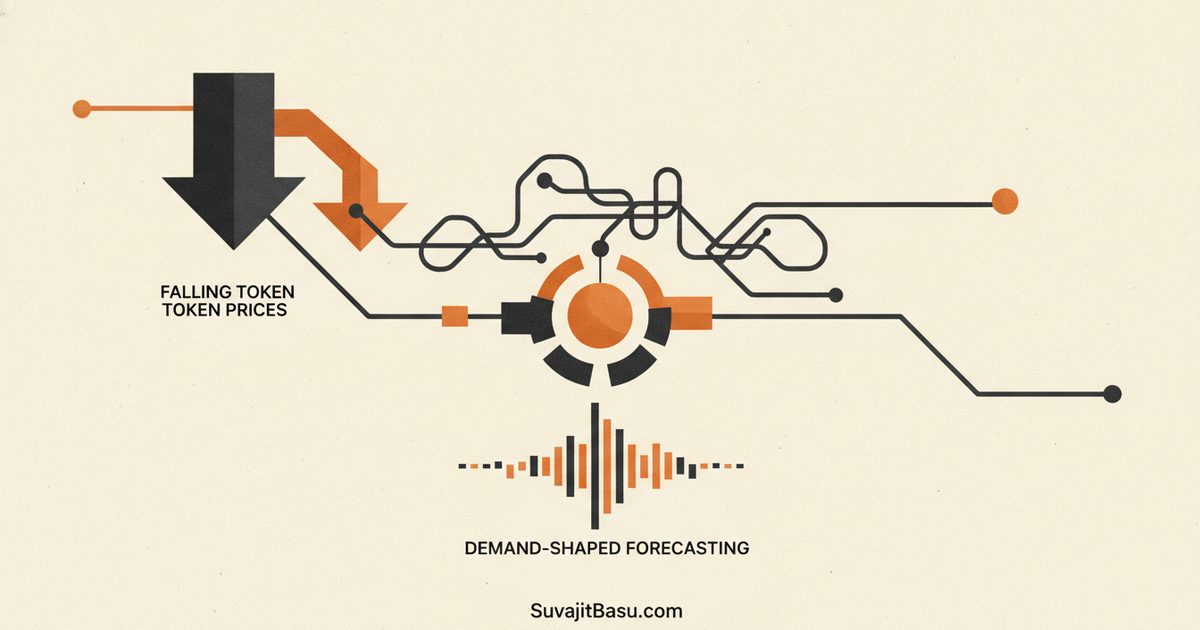
Cheaper tokens did not produce cheaper years. That is the CIO decision problem hiding inside every “good news” slide about AI unit costs.
Most technology outlooks still treat a falling price as a falling year. Seat-era planning trained leaders to read the sticker first and assume demand would hold still enough for the plan to survive. Agentic AI broke that habit. When a successful use case multiplies steps, retries, context, and orchestration, volume—not the unit price—sets the landing. A forecast that celebrates the rate while ignoring the demand curve is not optimism. It is a design error.
For CIOs, the operating question is no longer “Did we negotiate a better token price?” It is “If adoption works the way we hope, does our outlook still describe December—or only January’s commercial model?” Until that question can be answered in the room with Finance, cheaper tokens remain a press-release story, not a governable year.
What the market is already showing
The external record is catching up to what many CIO offices already feel mid-cycle. The Next Web reported that per-token prices have fallen on the order of ~98% from earlier frontier levels while enterprise AI bills rose sharply—driven by agentic workflows that consume far more tokens per task than earlier chat-style usage, and by industry moves toward a Tokenomics Foundation under the Linux Foundation to make those economics less opaque.
Business Insider described the end of the all-you-can-eat phase: providers shifting more customers toward usage-based economics, enterprises imposing internal token caps, and leaders cracking down on “tokenmaxxing” as the subsidy era gave way to calorie-counting. Unlimited access was a commercial phase, not a steady state—and forecasts still priced like a buffet will miss the menu economy.
TechTarget’s FinOps-for-AI coverage adds the ownership blur CIOs already recognize: AI spend spreads across IT, product, business units, and emerging AI offices; finance still needs a year-end narrative; and mature cloud FinOps accuracy does not automatically transfer to tokenomics. Forecast miss and ownership miss travel together.
These sources are evidence, not a digest. Together they confirm a single operating fact: price can fall while the year rises when demand, agents, and commercial models move faster than the outlook.
What changes in the CIO operating review
Most technology operating reviews still ask a seat-era question in token clothing: Are we on budget?
Under agentic and usage-based AI, that question is incomplete. “On budget” can mean the invoice has not arrived yet. It can mean one team’s caps hide another team’s unconstrained run rate. It can mean the plan assumed chat-scale consumption while production workflows now run multi-step agents, long contexts, and tool calls.
The review has to shift from unit-price optimism to a demand-shaped outlook:
Price is not the forecast. Falling unit costs can coexist with rising bills when volume and workflow intensity rise faster than price declines.
Adoption success changes the cost curve. A pilot that works is not a closed envelope; it is often a demand multiplier.
“Temporary” and “experimental” are forecast risks. If the review cannot see when temporary becomes permanent, the year-end story arrives as surprise.
Ownership ambiguity is a predictability risk. When IT, Finance, business sponsors, and AI leads each hold a slice of truth, the CIO still owns the executive narrative—whether or not the org chart makes that tidy.
Guardrails without outlook still fail the board. Caps may slow burn; they do not automatically produce a shared landing view the CFO can defend.
Put these questions on the table before debating another workbook version:
If token unit prices fell another 50% next quarter, would our AI outlook fall—or rise—given current adoption and agentic intensity?
Which AI workloads behave like seats (bounded, renewable) versus consumption (flex with demand), and does our forecast treat them differently?
Where has “experiment” become run-rate without a re-forecast?
When Finance and Technology disagree mid-year on AI spend, is the disagreement about data, timing, or ownership?
If a high-usage team hits internal limits, does the outlook update—or does spend simply move to another channel we see later?
Can we explain the AI landing in one narrative: committed vs. movable, owned vs. orphaned, value-linked vs. still exploratory?
If those questions are hard to answer in the room, the organization is still forecasting yesterday’s commercial model.
What CFOs will ask next
CFOs will not open with model names. They will open with landing, variance, and accountability.
Expect versions of:
Where will AI land at year-end—and what still moves that number?
Why did unit prices fall while the bill rose? Finance will want the volume and workflow story, not a vendor press release.
Which spend is committed versus discretionary? Caps, commitments, and unconstrained usage look different in a forecast than they do in a demo.
Who owns the overrun if demand keeps compounding? Ownership blur stops being an org-chart debate once variance needs a name.
What evidence ties spend to outcome? Boards are increasingly intolerant of “AI is strategic” without a defensible link between consumption and value—or a deliberate decision that learning cost is the value for now.
For CFOs, the secondary but decisive concern is narrative integrity: one year-end story that does not fracture into IT’s usage view, Finance’s booked view, and a third rebuild before the board pack.
Evidence → decisions → outcomes
Token prices fell. AI bills rose. That is not a paradox once volume, agents, and commercial shifts are in the frame—it is a forecast design failure waiting to be named.
CIOs do not need a more optimistic unit-cost story. They need an outlook that moves when demand moves, early enough to change decisions—not only early enough to explain variance after the invoice lands. CFOs will reward the same shift: a shared landing view over a post-hoc reconciliation.
The industry is racing toward standards and clearer tokenomics language. Enterprises cannot wait for the standards body to finish before the next operating review. The mandate is already here: treat enterprise AI token costs as a living forecast problem, not a static price win.
Evidence of what is moving. Decisions while options remain open. Outcomes the CIO and CFO can defend together.
Next step
TekLedger helps CIO and Finance leaders keep one decision-ready outlook on technology economics—evidence, decisions, outcomes—built from information you already maintain. Methodology stays in a private briefing.
Request a Private Briefing · See a Sample CIO Brief
Related Insights
More on the CIO Operating System as an evidence → decision → outcome layer:
What Is a CIO Operating System? — A CIO Operating System connects spend, priorities, risk, portfolio, ownership, scenarios, and decisions across existing enterprise systems.
From Seats to Consumption: The New Technology Forecasting Problem — When seats become consumption, annual seat×price forecasts stop describing the year. CIOs need technology consumption forecasting that moves with demand—early enough to act.
Consumption Pricing Changes the Technology Budget — Consumption pricing across cloud, data, software, and AI makes technology costs more variable and changes how CIOs need to forecast spend.
Your Technology Budget Was Built for a Different Economic Model — Most IT budgets still assume annual seats and stable run-rate. Cloud, SaaS, and AI moved the economics. Here’s why “approved” no longer means “predictable”—and what CIOs should ask next.