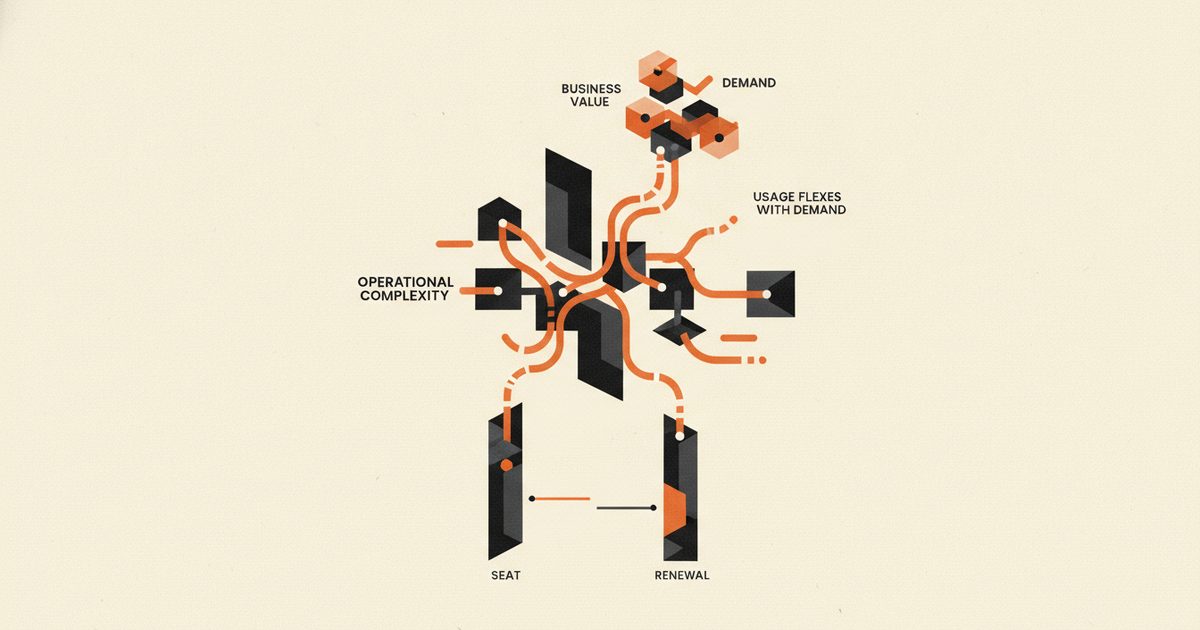
For years, technology forecasting rested on a comforting equation: seats times price, plus a few known projects, plus a contingency.
That equation worked when the dominant unit of technology economics was a license, a headcount proxy, or an annual commitment that changed slowly. The forecast could be built early, defended once, and treated as a reasonable map of the year.
Then the unit of economics shifted.
Cloud, modern SaaS, data platforms, and AI services increasingly charge for what the organization actually uses. Usage flexes with product velocity, experimentation, seasonal demand, and business adoption—not with the headcount plan locked in Q4.
The executive question is no longer subtle:
What happens when seats become consumption?
The short answer: seat×price forecasts stop describing the year. They describe last year’s commercial model.
Why seat-based forecasts felt safe
Seat-based planning gave CIOs and CFOs something rare in technology finance: a stable denominator.
Headcount plans were known months ahead
Renewals arrived on calendars you could put on a wall
True-ups were annoying, but they were bounded
Major changes usually required a purchasing event someone had to approve
In that world, forecast quality was mostly a function of planning discipline. If you counted seats carefully and controlled change orders, the outlook held.
Consumption pricing removes that stability without removing the accountability. Leadership still wants a year-end landing number. The economic driver just stopped sitting still.
That is the heart of the new forecasting problem. The organization did not become less disciplined. The commercial model became less static.
What consumption changes in the forecast
Consumption does not merely add a new line item. It changes the shape of risk.
Successful adoption can increase cost automatically. A pilot that works becomes enterprise demand. A data product that gains traction generates more processing. An AI capability that teams actually use creates inference and platform spend that did not exist at planning time.
Failure modes also look different. Under-forecasting is not only “we bought the wrong number of seats.” It is “demand arrived faster than the commercial model assumed,” or “a temporary workload never became temporary,” or “shadow usage compounded before anyone owned the outlook.”
Meanwhile, ownership gets harder. The platform team may operate the service. A business unit may drive the usage. A project may have introduced the workload. Finance may see the invoice weeks later. Each party can be correct about their slice—and the year-end outlook can still be wrong.
This is why many CIO–CFO conversations now feel like they are arguing about different years. One side is defending the plan built on seats and commitments. The other is living the movement created by usage.
The forecasting problem CIOs actually face
The problem is not that consumption is unknowable. The problem is that many forecast processes still behave as if the year will sit still after approval.
When usage flexes, a static annual model creates familiar executive symptoms:
“We are fine against budget” — until a late invoice or true-up lands
“AI is still small” — until unit cost and adoption compound
“We will clean it up at renewal” — after the negotiating window has narrowed
“Finance and IT have different numbers” — because each is looking at a different clock
Those are not spreadsheet failures first. They are timing and narrative failures. The forecast is answering last decade’s question—“Did we count the seats?”—while leadership is asking this decade’s question—“Where will we land if demand keeps moving?”
Once that mismatch sets in, the workbook grows and confidence falls. Teams rebuild the same story from different angles. The forecast becomes a reconciliation project instead of a decision instrument.
What a useful consumption-era forecast must do
A useful technology forecast in a consumption world is not a more elaborate license rollup. It is an operating instrument that can move with demand.
That means the CIO office needs an outlook that can distinguish:
What is already committed versus what can still move
Which usage shifts matter to year-end versus which are noise
Which changes require an owner this week versus which can wait for the next cycle
One defensible narrative for the CFO—not three reconciliations after the fact
The standard of quality changes with it. Forecast quality is no longer only “how close was January’s plan to December’s actuals.” It is “how early did we see the outlook change while we could still act?”
That is a different definition of predictability. Static accuracy against an outdated model is less valuable than timely movement against the real economic drivers.
Leaders do not need a perfect prediction of every workload. They need an outlook that stays honest when demand flexes—and that can be explained in the same language Finance uses for year-end landing.
Questions worth taking into the next forecast review
Before debating another version of the workbook, ask the sharper questions:
Which parts of our technology estate still behave like seats—and which now behave like consumption?
If usage doubled in a critical platform, would we see the year-end impact early enough to change a decision?
Where does “temporary” spend become permanent without a new executive conversation?
When Finance and the CIO office disagree mid-year, is it a data argument or a timing argument?
Can we explain the outlook in one narrative the CFO can defend—not three after-the-fact reconciliations?
If those questions are hard to answer, the forecast is still optimized for the commercial model that is shrinking, not the one that is growing.
The executive shift
Seats rewarded careful annual counting. Consumption rewards continuous judgment about demand, commitment, and timing.
CIOs do not need a forecast that pretends usage will hold still. They need a forecast that moves when demand moves—early enough to change the decision, not only early enough to explain the variance.
That is the new technology forecasting problem. Seat×price was a map. Consumption requires a living outlook.
Next step
TekLedger helps CIO offices turn technology economics into decision-ready outlooks—evidence, decisions, outcomes—built from information you already maintain. Methodology stays in a private briefing.
Request a Private Briefing · See a Sample CIO Brief
Related Insights
More on the CIO Operating System as an evidence → decision → outcome layer:
What Is a CIO Operating System? — A CIO Operating System connects spend, priorities, risk, portfolio, ownership, scenarios, and decisions across existing enterprise systems.
Consumption Pricing Changes the Technology Budget — Consumption pricing across cloud, data, software, and AI makes technology costs more variable and changes how CIOs need to forecast spend.
Token Prices Fell. AI Bills Rose. CIOs Need a Different Forecast. — Token prices fell ~98% while enterprise AI bills rose. CIOs need demand-shaped forecasts—not unit-price optimism—before the next CFO review of enterprise AI token costs.
Your Forecast Should Move Before Your GL Does — Where will we land at year end? A CIO technology forecast should register movement before the GL catches up—so CIO and CFO share one decision-ready outlook.