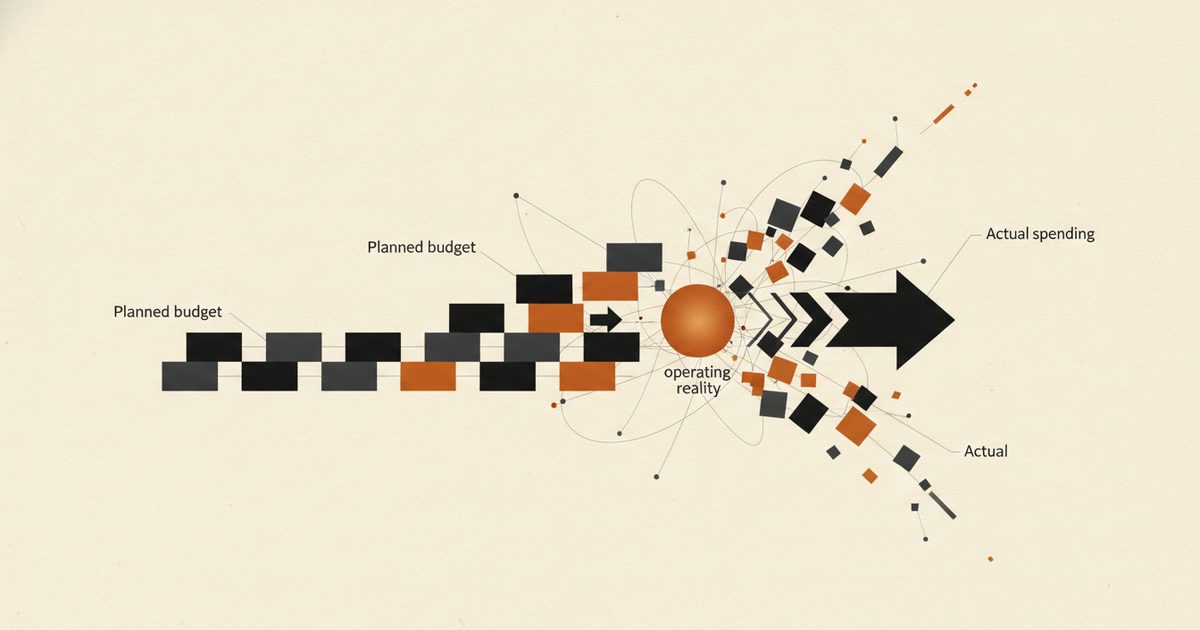
Most CIOs start the year with a budget that looks reasonably clear.
Projects are approved. Contracts are known. Cloud commitments are estimated. Headcount is planned. Major renewals are on the calendar.
Then the year begins.
Usage changes. Projects slip. Vendors increase prices. Business teams add software. Consumption grows. New initiatives are approved. Contracts renew differently than expected.
By the time the variance appears in the financial reports, the underlying decision may have happened weeks or months earlier.
That is the real budgeting problem.
The CIO does not need another spreadsheet showing that actual spend differs from budget. The CIO needs to understand what changed, why it changed, and what decision needs to be made next.
The budget is static. The environment is not.
Traditional budgeting works reasonably well when costs are predictable.
Technology increasingly behaves differently.
A growing portion of technology spend depends on consumption, usage, transactions, storage, compute, AI activity, data processing, or variable licensing.
That makes the operating model more dynamic.
A budget created months ago becomes less useful unless it can continuously incorporate what is actually happening.
Variance is the beginning of the conversation
Most financial reporting ends with variance:
Budget: $1.0M
Actual: $1.2M
Variance: $200K unfavorable
For the CIO, that is incomplete.
The useful questions are:
Why did the spend increase?
Was it expected?
Was the increase approved?
Will it continue?
Does the forecast need to change?
Is there an action required?
Those questions turn financial reporting into management information.
CIOs need an operating view of spend
The next generation of technology financial management should connect budget, actuals, contracts, vendors, projects, applications, and decisions.
The goal is simple.
The CIO should be able to see where the money is going, what changed, and what needs attention before someone else asks.
That is a different operating model from reviewing spreadsheets after the fact.
It moves technology finance closer to how CIOs actually run the business.
Related Insights
More on the CIO Operating System as an evidence → decision → outcome layer:
What Is a CIO Operating System? — A CIO Operating System connects spend, priorities, risk, portfolio, ownership, scenarios, and decisions across existing enterprise systems.
Your Technology Budget Was Built for a Different Economic Model — Most IT budgets still assume annual seats and stable run-rate. Cloud, SaaS, and AI moved the economics. Here’s why “approved” no longer means “predictable”—and what CIOs should ask next.
Your Forecast Should Move Before Your GL Does — Where will we land at year end? A CIO technology forecast should register movement before the GL catches up—so CIO and CFO share one decision-ready outlook.
A CIO Should Be Able to Explain Any Major Technology Variance — CIOs need more than budget variance reports. Connect technology spending changes to causes, ownership, evidence, and executive decisions.